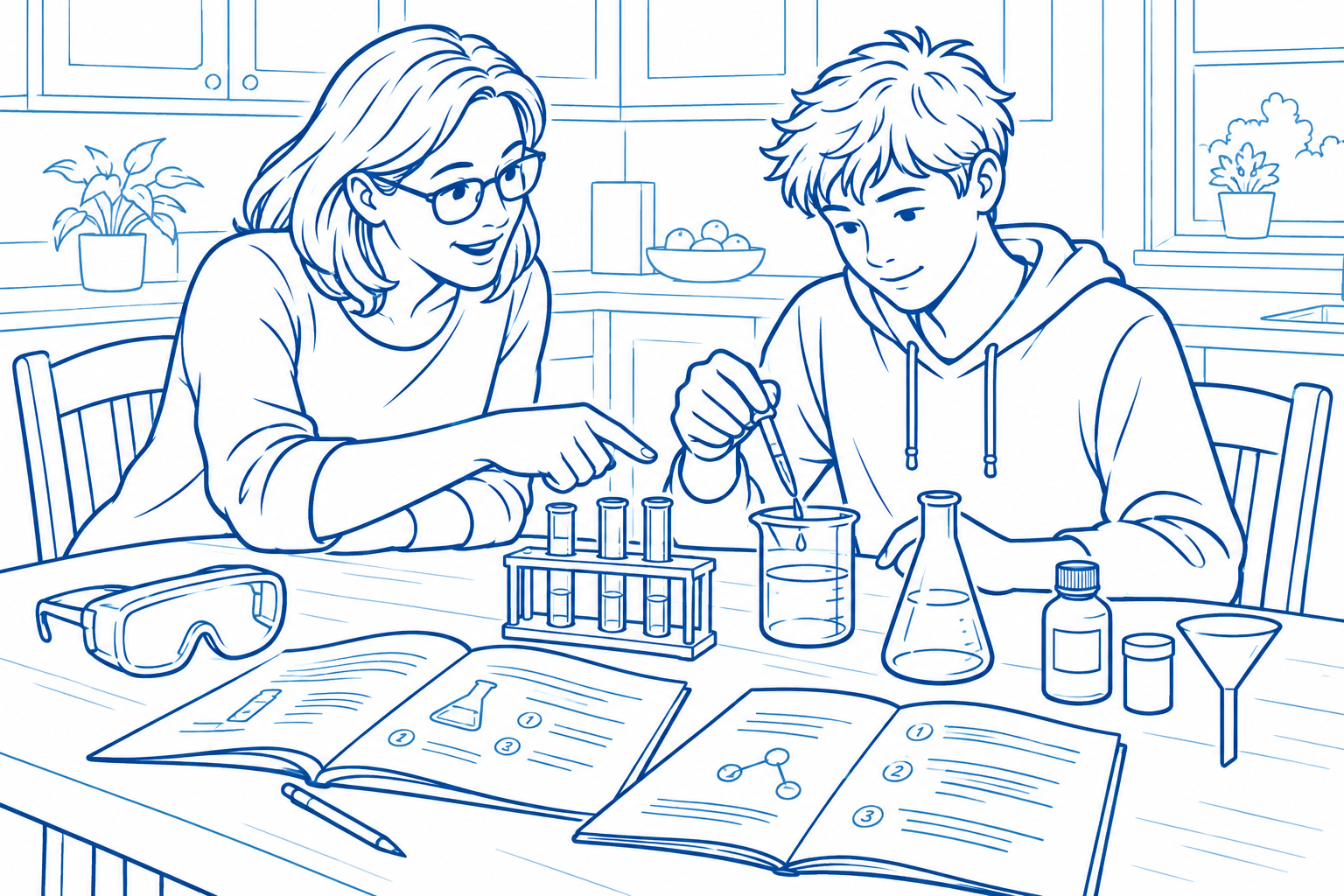
Science tutoring often begins with theory: introducing an idea, explaining the underlying principles and working through questions. A relevant hands-on activity can give a student another way to explore that theory and discuss what it means in practice.
Practical work does not need to sit separately from the rest of a tutoring session. By starting with a clear learning objective and using carefully chosen questions, tutors can make an activity part of a structured conversation about scientific ideas.
Start with a clear learning objective
Before choosing an activity, decide what the student should understand, test or observe. The practical task should support the topic being studied rather than simply filling time or providing a change of pace.
For example, consider which scientific principle the activity will illustrate and how the student’s observations will relate to it. This makes it easier to introduce the task, guide the discussion and return to the original learning point afterwards.
Ask for a prediction before beginning
Once the relevant theory has been introduced, ask the student to predict what might happen. Encourage them to explain the scientific reasoning behind their prediction rather than simply guessing an outcome.
Useful prompts might include:
- What do you expect to observe?
- Which scientific idea supports your prediction?
- What might we change, measure or compare?
- What result would support your explanation?
Recording an initial prediction also gives the student something specific to revisit after completing the activity.
Turn observations into a learning conversation
During the activity, ask the student to describe what they notice. Where appropriate, encourage them to distinguish between an observation and an explanation: what happened, and why do they think it happened?
Afterwards, return to the original prediction and theory. Questions such as these can help structure the discussion:
- Did the result match your prediction?
- Was anything unexpected?
- How do the observations relate to the theory?
- Would you change your original explanation?
- What further question could you investigate?
This reflection helps connect the practical task to the scientific concepts being studied.
Plan for the tutoring environment
Before recommending or carrying out any practical activity, consider the available lesson time, the teaching environment, the student’s suitability and the supervision required. Tutors should also review the instructions in advance so that they understand how the activity fits into the session.
STEM Kits supplies hands-on experiments for Key Stage 3 and Key Stage 4 exam preparation. The kits include instructions in English, exam hints and sample questions. Retail and subscription options are available, giving tutors and students routes to explore according to their learning plans.
Register for a personal tutor discount code
Bona fide science tutors can register free of charge to receive a personal discount code to share with their students. There is no minimum number of students and no commitment required. Students order directly from the STEM Kits website and enter the promotional code when purchasing.
The code gives students at least £10 off STEM Kits products. To get started, complete the tutor enquiry form; STEM Kits will then contact you with your unique code.
Register with STEM Kits to receive your personal tutor discount code and help your students add hands-on practical work to their science learning: